Content operations
How to build a 30-day small-business content plan
Consistency comes from a small editorial system: four themes, a few reusable formats, and a clear reason for every post.
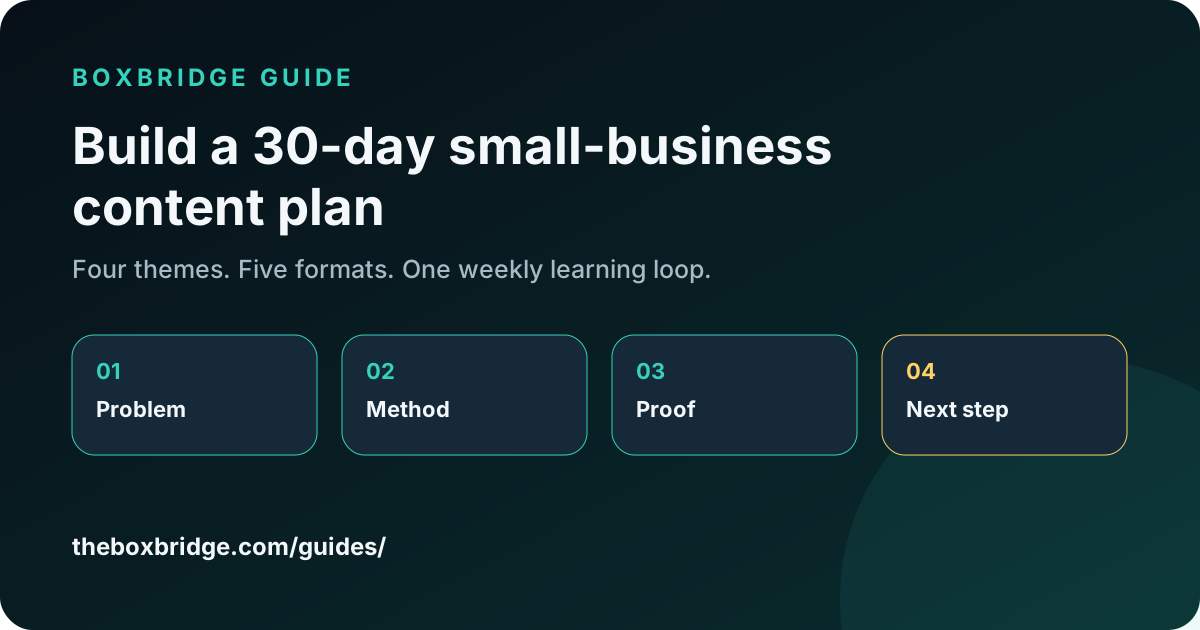
Choose one audience and one next step
A content plan gets easier when every piece helps the same kind of person move toward the same useful action. Pick one primary audience and one conversion path for the month: read a guide, download a resource, request a consultation, or inspect an offer.
Not every post needs a hard call to action. Every post should still support the same positioning.
Build four durable themes
-
Problem recognition
Name the costly symptom, common mistake, or hidden tradeoff. Help the reader diagnose before you prescribe.
-
Practical method
Teach a checklist, decision rule, small workflow, or example the reader can use today. Specific usefulness earns return visits.
-
Proof and process
Show how the work is made, tested, delivered, or improved. Use real evidence and label demonstrations or owner-controlled tests honestly.
-
Offer and next step
Explain who the offer is for, what it contains, what it does not promise, and the safest next action.
Rotate five reusable formats
- One useful sentence: a clear principle with one example.
- Checklist: three to seven steps that reduce uncertainty.
- Before and after: compare a vague approach with a specific one.
- Short teardown: explain what works, what fails, and what you would change.
- Question and answer: address one real objection without turning it into a sales script.
Four themes multiplied by five formats creates twenty combinations. Repeat the strongest ten with a new example, platform treatment, or level of depth to reach thirty without padding.
A simple weekly rhythm
- Monday: problem recognition.
- Tuesday: practical method.
- Wednesday: proof or process.
- Thursday: answer one objection.
- Friday: focused offer or resource.
- Weekend: repurpose the strongest idea and review results.
Protect quality: publishing three useful posts is better than filling seven slots with low-value variations. Treat the calendar as a queue, not a quota.
Measure the path, not applause
Record the platform, topic, format, tracked URL, publish date, impressions, meaningful engagements, link clicks, and downstream action. Review after a consistent period. A post with fewer reactions but more qualified clicks may be doing the better job.
Change one variable at a time: the opening, format, example, or call to action. Keep the audience and offer stable long enough to learn.
Turn one month into a repeatable system
Use the free BoxBridge planner for the launch, then adapt the four-theme system to the channel your audience already uses.